 Add to Chrome
 Add to Firefox
 Add to Edge
Formalizing and falsifying causal pathways of rare events
May 29, 2026
Building on recent formalizations of root cause analysis for rare events (``outliers'') in structural equation models, we propose a formal definition of a causal pathway and discuss its testable implications. We identify conditions under which these implications depend only on a causal abstraction defined by the pathway of rare events, rather than on the full causal graph of the underlying system. Accordingly, we introduce an abstraction of causal structure to pathways of rare events that bridges simple verbal causal explanations and detailed causal modeling.

Evaluating Bivariate Causal Statements Based on Mutual Compatibility
May 29, 2026For many real-world systems, causal ground truth is difficult to obtain, making claims about causal effects hard to assess. We develop methods for evaluating collections of $\binom{n}{2}$ bivariate causal statements over a set of $n$ variables. In the setting of acyclic linear statements, any such collection can be extended to a unique multivariate causal model, but we argue that this induced model is implausible if it imposes substantial additional confounding to explain observed correlations. We introduce a compatibility score that quantifies this notion of plausibility, notably without relying on the faithfulness assumption. Additionally, we define an incompatibility score for purely graphical bivariate causal statements, based on global consistency constraints that are derived from acyclicity and faithfulness assumptions. We give theoretical and empirical evidence that both scores can successfully distinguish correct from incorrect causal statements in generic settings. Moreover, we demonstrate the practical applicability of our methods by analyzing causal claims made by large language models. Our work aims to provide a foundation for assessing the reliability of causal information derived from human experts or artificial intelligence in settings where alternative forms of validation are unavailable.
IV Co-Scientist: Multi-Agent LLM Framework for Causal Instrumental Variable Discovery
Feb 08, 2026In the presence of confounding between an endogenous variable and the outcome, instrumental variables (IVs) are used to isolate the causal effect of the endogenous variable. Identifying valid instruments requires interdisciplinary knowledge, creativity, and contextual understanding, making it a non-trivial task. In this paper, we investigate whether large language models (LLMs) can aid in this task. We perform a two-stage evaluation framework. First, we test whether LLMs can recover well-established instruments from the literature, assessing their ability to replicate standard reasoning. Second, we evaluate whether LLMs can identify and avoid instruments that have been empirically or theoretically discredited. Building on these results, we introduce IV Co-Scientist, a multi-agent system that proposes, critiques, and refines IVs for a given treatment-outcome pair. We also introduce a statistical test to contextualize consistency in the absence of ground truth. Our results show the potential of LLMs to discover valid instrumental variables from a large observational database.
From Guess2Graph: When and How Can Unreliable Experts Safely Boost Causal Discovery in Finite Samples?
Oct 16, 2025Causal discovery algorithms often perform poorly with limited samples. While integrating expert knowledge (including from LLMs) as constraints promises to improve performance, guarantees for existing methods require perfect predictions or uncertainty estimates, making them unreliable for practical use. We propose the Guess2Graph (G2G) framework, which uses expert guesses to guide the sequence of statistical tests rather than replacing them. This maintains statistical consistency while enabling performance improvements. We develop two instantiations of G2G: PC-Guess, which augments the PC algorithm, and gPC-Guess, a learning-augmented variant designed to better leverage high-quality expert input. Theoretically, both preserve correctness regardless of expert error, with gPC-Guess provably outperforming its non-augmented counterpart in finite samples when experts are "better than random." Empirically, both show monotonic improvement with expert accuracy, with gPC-Guess achieving significantly stronger gains.
Root Cause Analysis of Outliers in Unknown Cyclic Graphs
Oct 08, 2025We study the propagation of outliers in cyclic causal graphs with linear structural equations, tracing them back to one or several "root cause" nodes. We show that it is possible to identify a short list of potential root causes provided that the perturbation is sufficiently strong and propagates according to the same structural equations as in the normal mode. This shortlist consists of the true root causes together with those of its parents lying on a cycle with the root cause. Notably, our method does not require prior knowledge of the causal graph.
On Different Notions of Redundancy in Conditional-Independence-Based Discovery of Graphical Models
Feb 12, 2025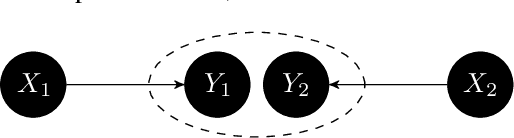

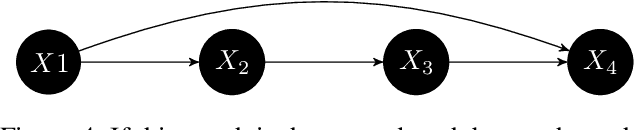
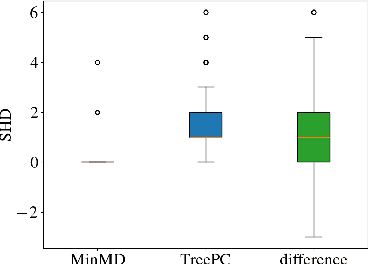
The goal of conditional-independence-based discovery of graphical models is to find a graph that represents the independence structure of variables in a given dataset. To learn such a representation, conditional-independence-based approaches conduct a set of statistical tests that suffices to identify the graphical representation under some assumptions on the underlying distribution of the data. In this work, we highlight that due to the conciseness of the graphical representation, there are often many tests that are not used in the construction of the graph. These redundant tests have the potential to detect or sometimes correct errors in the learned model. We show that not all tests contain this additional information and that such redundant tests have to be applied with care. Precisely, we argue that particularly those conditional (in)dependence statements are interesting that follow only from graphical assumptions but do not hold for every probability distribution.
Toward Universal Laws of Outlier Propagation
Feb 12, 2025We argue that Algorithmic Information Theory (AIT) admits a principled way to quantify outliers in terms of so-called randomness deficiency. For the probability distribution generated by a causal Bayesian network, we show that the randomness deficiency of the joint state decomposes into randomness deficiencies of each causal mechanism, subject to the Independence of Mechanisms Principle. Accordingly, anomalous joint observations can be quantitatively attributed to their root causes, i.e., the mechanisms that behaved anomalously. As an extension of Levin's law of randomness conservation, we show that weak outliers cannot cause strong ones when Independence of Mechanisms holds. We show how these information theoretic laws provide a better understanding of the behaviour of outliers defined with respect to existing scores.
Causal vs. Anticausal merging of predictors
Jan 14, 2025

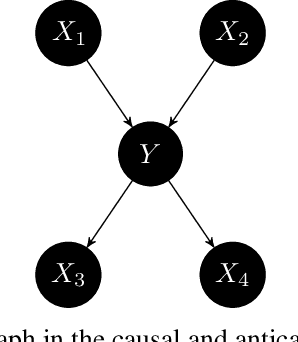
We study the differences arising from merging predictors in the causal and anticausal directions using the same data. In particular we study the asymmetries that arise in a simple model where we merge the predictors using one binary variable as target and two continuous variables as predictors. We use Causal Maximum Entropy (CMAXENT) as inductive bias to merge the predictors, however, we expect similar differences to hold also when we use other merging methods that take into account asymmetries between cause and effect. We show that if we observe all bivariate distributions, the CMAXENT solution reduces to a logistic regression in the causal direction and Linear Discriminant Analysis (LDA) in the anticausal direction. Furthermore, we study how the decision boundaries of these two solutions differ whenever we observe only some of the bivariate distributions implications for Out-Of-Variable (OOV) generalisation.
Cross-validating causal discovery via Leave-One-Variable-Out
Nov 08, 2024We propose a new approach to falsify causal discovery algorithms without ground truth, which is based on testing the causal model on a pair of variables that has been dropped when learning the causal model. To this end, we use the "Leave-One-Variable-Out (LOVO)" prediction where $Y$ is inferred from $X$ without any joint observations of $X$ and $Y$, given only training data from $X,Z_1,\dots,Z_k$ and from $Z_1,\dots,Z_k,Y$. We demonstrate that causal models on the two subsets, in the form of Acyclic Directed Mixed Graphs (ADMGs), often entail conclusions on the dependencies between $X$ and $Y$, enabling this type of prediction. The prediction error can then be estimated since the joint distribution $P(X, Y)$ is assumed to be available, and $X$ and $Y$ have only been omitted for the purpose of falsification. After presenting this graphical method, which is applicable to general causal discovery algorithms, we illustrate how to construct a LOVO predictor tailored towards algorithms relying on specific a priori assumptions, such as linear additive noise models. Simulations indicate that the LOVO prediction error is indeed correlated with the accuracy of the causal outputs, affirming the method's effectiveness.
Root Cause Analysis of Outliers with Missing Structural Knowledge
Jun 07, 2024Recent work conceptualized root cause analysis (RCA) of anomalies via quantitative contribution analysis using causal counterfactuals in structural causal models (SCMs). The framework comes with three practical challenges: (1) it requires the causal directed acyclic graph (DAG), together with an SCM, (2) it is statistically ill-posed since it probes regression models in regions of low probability density, (3) it relies on Shapley values which are computationally expensive to find. In this paper, we propose simplified, efficient methods of root cause analysis when the task is to identify a unique root cause instead of quantitative contribution analysis. Our proposed methods run in linear order of SCM nodes and they require only the causal DAG without counterfactuals. Furthermore, for those use cases where the causal DAG is unknown, we justify the heuristic of identifying root causes as the variables with the highest anomaly score.